Print Technology Explained: What It Means for Laser Printers
As an Amazon Associate we earn from qualifying purchases. Links on this page are affiliate links.
Understanding LED Print Technology
When you browse laser printers, you will see the term print technology explained in various ways. Most machines use a laser, but some use Light Emitting Diodes. This specification matters because it changes how the printer creates an image on the page. You need to know the difference to choose the right device for your office.
Laser printers use a single laser beam to draw lines on a photosensitive drum. The beam moves back and forth rapidly. LED printers use a fixed bar of thousands of tiny diodes. This bar sits directly above the drum. When the printer starts, the diodes light up in a pattern. This pattern exposes the drum instantly. There is no moving laser mechanism. The result is a static image on the drum surface.
You will find this spec listed as "LED" or "Solid State" on product pages. It is distinct from "Laser" or "Electrostatic." If a listing says LED, it means the imaging unit is stationary. This design has practical implications for you. Fewer moving parts often mean less wear over time. The print head does not need to accelerate or decelerate. It simply turns on or off.
Speed is another factor. Because the diodes activate all at once, the exposure time is nearly instant. This can help with consistent print speeds. However, the resolution depends on the diode density. You should check the dots per inch rating. Higher density means sharper text and images. This technology is common in compact office printers. It offers reliable performance for high-volume text documents. You should verify the drum type and toner capacity as well. These specs work together to determine your total cost of ownership. Understanding the core mechanism helps you evaluate durability and output quality accurately.
LED Print Technology Options
LED
LED printers use an array of light-emitting diodes to expose the imaging drum. This design replaces the moving laser mirror found in traditional laser printers. The result is fewer mechanical parts, which often leads to higher reliability and lower maintenance costs. You benefit from consistent image quality and reduced heat generation during operation. The Kyocera ECOSYS P2235dw exemplifies this approach. It combines wireless connectivity and duplex scanning with a compact white chassis. The OKI B4600 offers a wired alternative. It suits offices that prioritize stable monochrome output over network flexibility. LED technology remains a practical choice for teams seeking durable, efficient printing without the complexity of color systems.
Laser
Laser printers use a rotating mirror to direct a laser beam across the imaging drum. This mechanism allows for precise control of the light path, enabling high-resolution output. The technology is well-established and widely supported across various office environments. You typically find this in machines that handle large volumes of text and graphics. While LED printers offer simplicity, laser models often provide greater versatility in color printing and advanced finishing options. The choice depends on your specific need for speed versus mechanical simplicity. Most standard office workflows rely on laser technology for its proven performance and broad compatibility with diverse document types.
Is LED Print Tech Worth It
Who needs it
You should prioritize this specification if your workflow demands consistent, high-volume output with minimal downtime. LED technology relies on a fixed array of diodes rather than moving mirrors, which reduces mechanical wear. This design choice often translates to higher reliability and lower maintenance needs over time. If you manage a busy office where printer failures disrupt daily operations, the reduced complexity of LED engines provides peace of mind. You benefit from fewer parts that can break or require replacement. This stability ensures that your printing tasks remain uninterrupted during peak hours. The technology also tends to offer faster warm-up times, allowing you to start jobs immediately. For environments where uptime is critical and maintenance resources are limited, choosing an LED printer supports smoother, more predictable operations without unexpected service interruptions.
Who can skip it
You can ignore this specification if your printing volume is low or occasional. The differences in print speed and quality between LED and laser engines are often negligible for casual users. If you primarily print documents a few times a week, the reliability advantages of LED technology do not provide significant value. Instead, focus on other factors that impact your daily experience, such as paper capacity, connectivity options, and duplexing capabilities. These features often matter more for home offices or small teams. You might also prioritize color output or specific software integrations that align with your current workflow. The core printing mechanism is less important than the overall functionality and ease of use. Select a model that fits your physical space and network requirements. Do not let the print technology specification drive your decision if your needs are simple and infrequent.
Laser Printer Glossary
Print Output
The physical result of your printing job, including page quality and consistency. You want sharp text and accurate color reproduction for professional documents.
Print Technology
The method used to create images, such as laser or LED. This choice affects mechanical complexity, reliability, and the overall lifespan of the device.
Printer Type
The category of the machine, like monochrome or color. Monochrome devices handle black text efficiently, while color models support graphics and vibrant presentations.
Print Speed
How fast the machine produces pages, measured in pages per minute. Higher speeds reduce wait times for large batches of reports or invoices.
Supported Functions
Features beyond basic printing, such as scanning or copying. Multi-function devices save desk space by combining several tools into one compact unit.
Print Resolution
The detail level of the output, measured in dots per inch. Higher resolution ensures crisp text edges and smooth gradients in photos or charts.
Connectivity
How the printer links to your devices, via Wi-Fi or Ethernet. Reliable connections ensure stable data transfer and easy access from multiple workstations.
Paper Tray Capacity
The number of sheets the tray holds before needing a refill. Larger capacity reduces interruptions during high-volume printing tasks and daily office workflows.
Quick picks
| # | Product | Best for | Price |
|---|---|---|---|
| 1 | OKI Monochrome LED Printer | monochrome desktop printing with legacy parallel connectivity | Check price of OKI Monochrome LED Printer on Amazon |
| 2 | Kyocera ECOSYS Monochrome LED Printer | High-speed monochrome office printing | Check price of Kyocera ECOSYS Monochrome LED Printer on Amazon |
| 3 | OKI B4600 Mono LED Printer | high-volume monochrome printing tasks | Check price of OKI B4600 Mono LED Printer on Amazon |
Our 3 picks
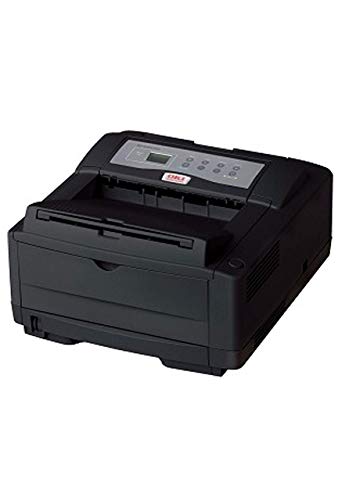
OKI Monochrome LED Printer
Best for: monochrome desktop printing with legacy parallel connectivity
- Print Technology
- LED (what this guide is about)
- Print Speed
- 27 ppm
- Connectivity
- USB, Parallel
View on Amazon: OKI Monochrome LED Printer Affiliate link
This monochrome printer uses LED print technology rather than traditional laser beams to produce documents at 600 x 2400 dpi resolution. It delivers print speeds up to 27 pages per minute and connects through standard USB or legacy parallel ports. If you need dedicated black-and-white text printing with simple wired connections, this unit handles straightforward desktop workloads.
Pros
- LED print technology
- 600 x 2400 dpi resolution
- Print speed of 27 ppm
- Parallel and USB connectivity options
Cons
- Print speed of 27 ppm is lower than competing models
- No wireless networking options listed
Good fit if
- You require legacy parallel or standard USB wired connections.
- You want 600 x 2400 dpi monochrome LED output.
- You need print output speeds up to 27 pages per minute.
Skip if
- You need built-in wireless or network connectivity.
- You require color document printing.
Verdict: OKI Monochrome LED Printer suits offices that require straightforward monochrome text output and legacy parallel port connectivity.

Kyocera ECOSYS Monochrome LED Printer
Best for: High-speed monochrome office printing
- Print Technology
- LED (what this guide is about)
- Print Output
- Monochrome
- Print Speed
- 37 ppm
- Connectivity
- Gigabit Ethernet, Wireless, Wi-Fi Direct
- Duplex Printing
- Auto-Duplex
- Print Resolution
- Up to 1200 dpi
View on Amazon: Kyocera ECOSYS Monochrome LED Printer Affiliate link
The Kyocera ECOSYS P2235dw uses LED print technology to deliver monochrome output at 37 pages per minute. It supports up to 1200 dpi resolution for sharp text. The unit includes auto-duplex printing and wireless connectivity options like Wi-Fi Direct. With an 850-sheet paper capacity and mobile printing compatibility, it suits small offices needing reliable, high-speed document production without color capabilities.
Pros
- 37 ppm print speed for fast output
- Up to 1200 dpi print resolution
- Auto-duplex printing saves paper
- Wireless and Wi-Fi Direct connectivity
- 850-sheet standard paper capacity
Cons
- Monochrome output only, no color printing
- No integrated scanner hardware listed
- Dimensions are 14.8 x 15.5 x 10.7 inches
Good fit if
- You need fast, high-volume monochrome printing
- You require wireless mobile printing support
- You want auto-duplexing to reduce paper use
Skip if
- You require color printing capabilities
- You need an all-in-one device with scanning
- You prefer LED technology over laser
Verdict: Kyocera ECOSYS P2235dw Mono LED Printer is a solid choice for teams prioritizing speed and wireless convenience in a monochrome workflow. It fits offices that need reliable daily output without the bulk of color features.

OKI B4600 Mono LED Printer
Best for: high-volume monochrome printing tasks
- Print Technology
- LED (what this guide is about)
- Print Speed
- 27 ppm
- Connectivity
- Parallel, USB
- Dimensions
- 18 × 19.1 × 13 inches
- Weight
- 15.4 pounds
View on Amazon: OKI B4600 Mono LED Printer Affiliate link
The OKI B4600 is a monochrome LED printer designed for steady output. It prints at 27 pages per minute with a resolution of 600 x 2400 dpi. The unit includes a 250-sheet input tray and supports USB and parallel connections. Its maximum duty cycle reaches 40,000 pages per month. This model suits offices needing reliable black-and-white printing without color complexity.
Pros
- LED print technology for consistent monochrome output
- 27 pages per minute print speed
- High maximum duty cycle of 40,000 pages
- 600 x 2400 dpi resolution
- 250-sheet input tray capacity
Cons
- Lacks wireless connectivity options like Wi-Fi
- Only supports USB and parallel connections
- No color printing capability
Good fit if
- You need a dedicated black-and-white printer
- You prefer wired USB or parallel connections
- You require a high monthly duty cycle
Skip if
- You need color printing capabilities
- You require wireless network connectivity
- You need mobile printing support
Verdict: OKI B4600 Mono LED Printer fits offices that prioritize wired reliability and high-volume monochrome output over wireless convenience.
Specifications side by side
| Spec | OKI Monochrome LED Printer | Kyocera ECOSYS Monochrome LED Printer | OKI B4600 Mono LED Printer |
|---|---|---|---|
| Print Technology | LED | Laser | LED |
| Print Output | not stated | Monochrome | not stated |
| Print Speed | 27 ppm | 37 ppm | 27 ppm |
| Connectivity | USB, Parallel | Gigabit Ethernet, Wireless, Wi-Fi Direct | Parallel, USB |
| Duplex Printing | not stated | Auto-Duplex | not stated |
| Print Resolution | not stated | Up to 1200 dpi | not stated |
| Features | not stated | Duplex Printing, Mobile Printing | not stated |
| Scanner Type | not stated | Portable | not stated |
| Scanning | not stated | Wireless Scanning | not stated |
| Duplex Scanning | not stated | Duplex | not stated |
| Dimensions | not stated | 15.5 × 14.8 × 10.7 inches | 18 × 19.1 × 13 inches |
| Weight | not stated | 30.9 pounds | 15.4 pounds |
| Model | B4600 | 4105851 | B4600 |
| Color | not stated | White | White |
Frequently asked questions
How does LED print technology differ from laser technology?
LED printers use a fixed array of light-emitting diodes to expose the imaging drum, while laser printers use a moving laser beam and rotating mirrors. This structural difference means LED machines have fewer moving mechanical parts. Fewer moving parts often lead to higher reliability and lower maintenance requirements for your office equipment.
Are LED printers suitable for high-volume office printing?
Yes, LED printers are well-suited for high-volume tasks. The fixed LED array reduces mechanical wear compared to moving laser mirrors. This design supports consistent output with minimal downtime, making it a solid choice for teams that print monochrome documents regularly and value wired stability over wireless flexibility.
Do LED printers support wireless connectivity?
Some models do support wireless connections. For example, the Kyocera ECOSYS P2235dw offers both wireless and Ethernet connectivity options. Other models, like the OKI B4600, prioritize wired reliability and may not include wireless features. You should check the specific connectivity specs for the model you are considering.
Can LED printers handle duplex printing automatically?
Many modern LED printers support automatic duplex printing. The Kyocera ECOSYS P2235dw includes duplex printing features to help you save paper. This functionality allows you to print on both sides of the page without manual intervention, which is useful for creating professional reports and reducing paper costs.
What print resolution can I expect from an LED printer?
Print resolution varies by model, but many offer up to 1200 dpi. The Kyocera ECOSYS P2235dw provides this level of detail for sharp text and clear graphics. Higher resolution ensures accurate color reproduction and consistent page quality, which is essential for professional documents and business communications.
Is LED technology more energy efficient than laser?
LED technology is often considered efficient due to its design. The fixed diode array consumes power differently than a moving laser system. While specific wattage figures are not listed here, the reduced mechanical complexity can contribute to lower maintenance and potentially better energy performance for your office environment.
Do LED printers require frequent toner replacements?
Toner replacement frequency depends on your print volume and the specific model. LED printers are designed for reliability, which can extend the life of components. However, you should monitor your monthly duty cycle and toner levels to ensure continuous operation without unexpected interruptions in your daily workflow.